

Alhamdulilah
Kokani Muslims are descendants of Arabs
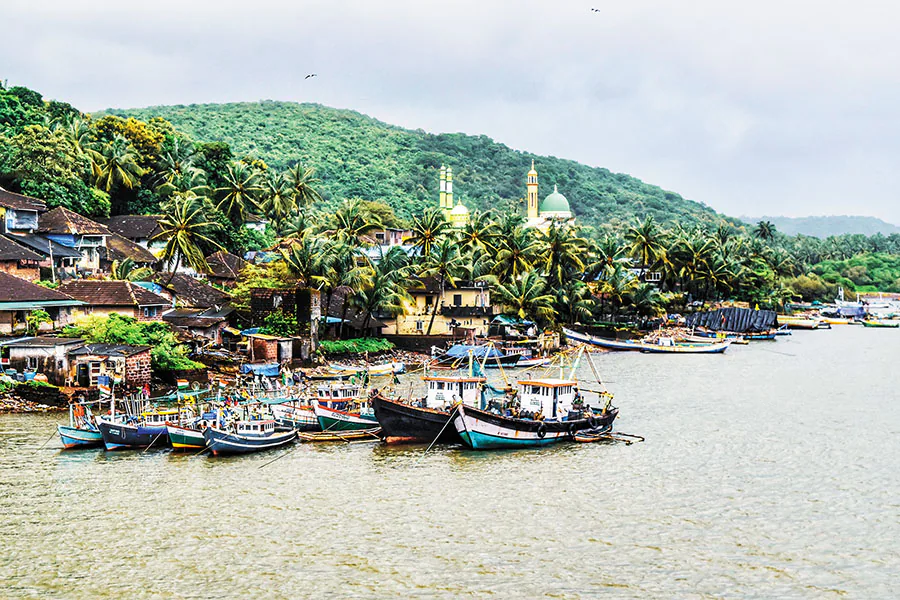
Kokani Muslims is a Muslim sub-ethnic group of Maharashtra Muslims living in the Kokan region of India. A good number of them live in Mumbai. There is a large Kokani Muslim diaspora community of economic migrants working in the Arab Gulf States, UK, USA and South Africa (where they have been established for a century).
Kokani Muslims trace their ancestry back to the Arab traders who arrived on the Western coast of India during the medieval era while some are descended from intermarriages with converts. In medieval times there was trading between the ports in Iraq, Oman, Yemen and the Indian ports of Sopara, Goa and Mahim (in Bombay).
Muslims of the Kokan and Malabar coasts represent the oldest Islamic settlements in India. The most obvious characteristic of these Muslims is the common origin as maritime mercantile communities.
In addition to their status as the vanguards of Islam in India, they are especially interesting to students of Islam in South Asia as they evolved in upper caste Hindu area. Muslims first arrived in the Kokan in 699, according to Jalal al-Din al-Suyuti, less than 70 years after the death of Prophet Muhammad in circa 632. In other words some Muslims were already present in India a decade before the invasion of Sindh by Muhammad ibn Qasim in 711.
Muslim communities that sprang up on the Kokan coast of India in the seventh century share three common characteristics: the first is a common origin in the Arabian Peninsula and the Persian Gulf region, second is a common adherence to the Shafi’i school of Islamic law and Sufism, and finally the common descent from Arab mariners and merchants.
Arab merchants and soldiers came to Kokan coast between the 7th and 10th centuries.The accounts of the Arab traveller Suliman state that the Balhars who ruled Kokan in the mid 9th century were friendly to the Arabs. Arabs settled in large numbers in Kokan towns. From the 14th to 16th more Arab and now Persian Muslims settled in Kokan.
The Kokani Muslims are divided in two classes known foreign and indigenous Muslims.
The foreign formed the upper class and have Arab and Persian ancestry. They married amongst each other. The progeny of these Arabs and Persians lived mainly in inland villages and are involved agriculture, forestry and mango orchards. The second is indigenous Muslims.
Koknis are strong followers of the Sunni Sufi Islam. One of the earliest Saints in Bombay, India was Kokni of Arab descent.
Makhdoom Ali Faqih Mahimi (1372-1431) was a Sufi saint from the Konkan in India, widely acknowledged for his scholarly treatise, liberal views and humanist ideals. Mahimi was born into a family of Arab travellers who had settled down on the island of Mahim, one of the seven islands that later formed the city of Bombay (now Mumbai).
Not much is known of his early childhood. He later became the disciple of Mohiuddin Ibn Arabi, a Spanish based saint revered by Muslims. Mahimi’s reputation grew after the sultan of Gujarat, Ahmed Shah of the Muzaffarid dynasty, chose him to be the town’s Qazi (the head Muslim cleric of a town).
Mahimi was the first Indian scholar to have written an exegesis on the Qur’an, which gained critical acclimation from numerous Islamic scholars including Shah Waliullah. Authoring a total of nineteen books, he was given the moniker Qutb al Kokan (Kokan’s Pole Star). Qutb or Pole is the Sufi term for the highest saint of an area or era. Mahimi is revered by both the Muslims and Hindus, all Muslim sects hold him in high esteem. After his death in 1431, he was buried in Mahim itself. The site later became a Mazaar(shrine) for devotees.
Thus Kokani Muslims, are the oldest Muslim communities in India. In the 1300 years of their existence, they have been acutely conscious of being Muslim as well as being perceived as such by others. Throughout their long history, the Kokani Muslims have overcome the triple challenges of surviving the assimilative power of syncretistic Hinduism, the crusading zeal of the Portuguese backed by their armed invasions in the sixteenth century, and the subsequent challenge posed by westernization as represented by the British colonial power. Surviving as a distinct Muslim community is no small achievement particularly when seen in the light of the fact there were no Muslim political powers to protect them when they first landed, nor when the power of Muslim sultanates waned in the eighteenth century. The story of the Kokani Muslims despite its antiquity and success is a mystery to most outsiders, and is truly fascinating.
The first Masjid to be built in Bombay, was by a wealthy Kokani merchant,
Jummah Masjid Bombay. Still under their control up to today.
Sources :
Maharastra state Gazette
Mumbai news
